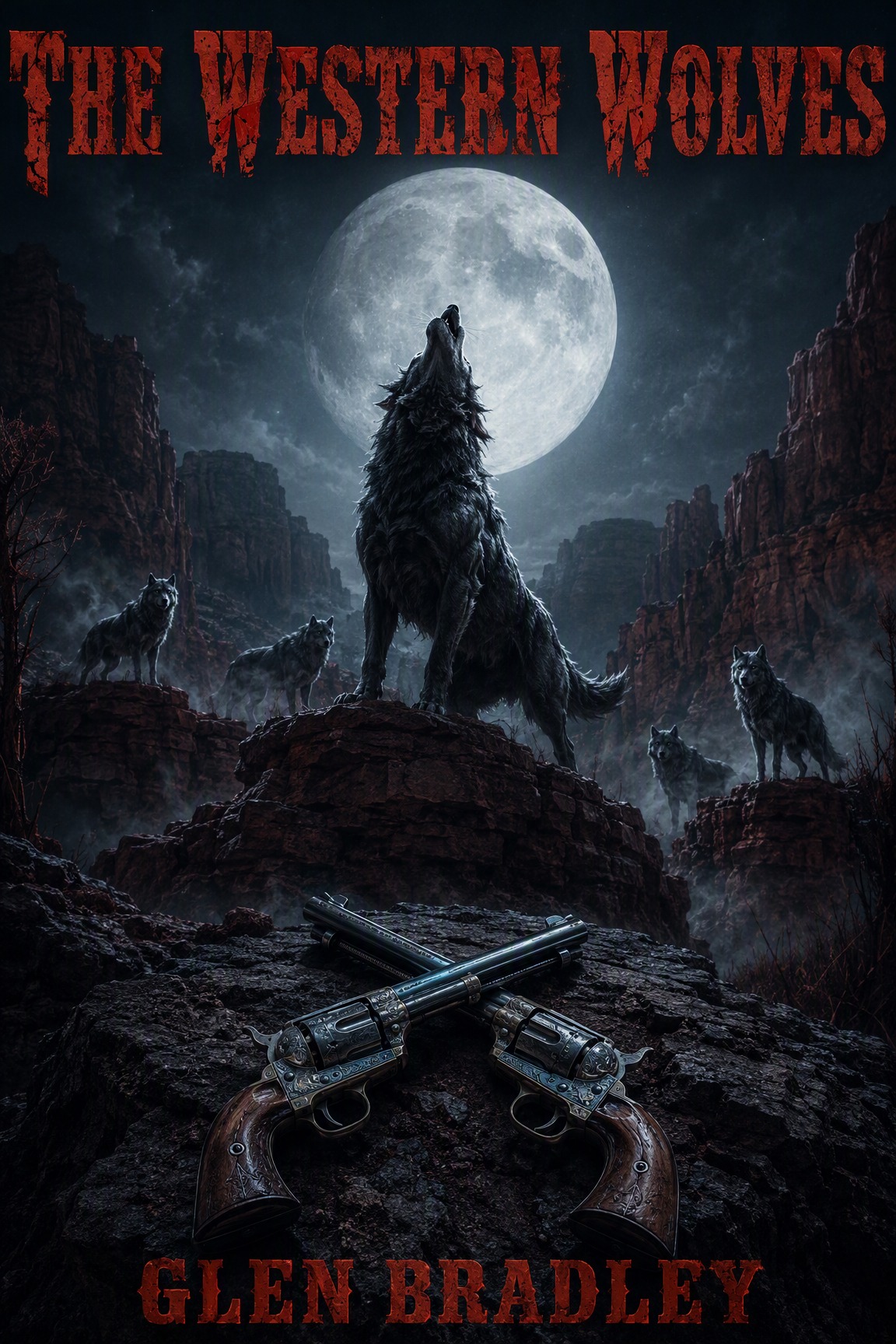
Chapter One — The Silver Tooth
The first time Pete Mandalay saw his brother lose a tooth, Tony was smiling.
That was Tony’s trouble. Pain had always interested him more than it frightened him.
The card room behind the Coyote House was not much of a room. Four walls leaned toward one another above a dirt floor, and a lamp smoked from a nail driven into a roof beam. Men played beneath it because the whiskey was cheap and because Sheriff Loomis did not care what happened behind the Coyote so long as nobody dragged a body into the main street before breakfast.
Tony sat with his hat pushed back and three dollars he did not own stacked beside his elbow.
Pete stood against the wall.
He had been standing there long enough to know his brother was cheating.
He also knew Tony knew that he knew.
That was how most of their conversations worked.
The dealer was a broad man named Harlan Pike, with a moustache yellowed by tobacco and hands like shovel heads. He had been losing for twenty minutes and becoming quieter with every hand.
Tony liked quiet men. He said they were easier to hear coming.
“Call,” Tony said.
Pike looked at him.
Tony laid down two pair.
Pike stared at the cards, then at Tony’s right sleeve.
Pete closed his eyes.
“Oh, hell,” he said.
Tony grinned.
Pike reached across the table and caught Tony by the wrist.
An ace slid from Tony’s cuff and landed face-up between them.
Nobody moved.
Tony looked down at it.
Then he looked back at Pike.
“That yours?”
Pike hit him.
The chair went over backward. Tony struck the wall hard enough to shake dust from the rafters.
Pete was already moving when Pike hauled Tony upright by the collar and hit him again.
The second blow made a different sound.
Something small crossed the lamplight and clicked on the floor.
Tony spat blood.
His smile was gone.
Pike bent to pick up the tooth.
Pete drew.
The room changed.
Men who had been leaning forward leaned back. One hand froze halfway to a holster. Another man slowly lifted both palms from the table.
Pete did not remember deciding to draw. He rarely did.
The revolver was simply there.
Its muzzle rested an inch from Pike’s left eye.
“Put him down.”
Pike looked at Pete, then at the gun.
“You the brother?”
“Depends who’s asking.”
“The one they call Pistolero Pete?”
Pete hated the name.
Tony loved it.
Pike released Tony.
Tony dropped to one knee, wiped his mouth with the back of his hand and examined the blood as though somebody else had produced it.
Pete said, “We’re leaving.”
“No,” Pike said.
Pete looked at him.
Pike nodded toward the tooth on the floor.
“Your brother owes me.”
Tony laughed wetly.
Pete wanted to hit him himself.
“What’s the price?”
Pike’s gaze stayed on Tony. “He cheated.”
“You noticed.”
“I want satisfaction.”
Tony stood.
One of his front teeth was missing. Blood filled the gap.
He looked absurd.
He also looked delighted.
“Outside, then.”
Pete turned on him. “Tony.”
“What?”
“You can barely stand.”
“Then he’s got the advantage.”
Pike smiled.
Not Tony against Pike.
Pete against Pike.
Tony had somehow cheated badly enough to get his own tooth knocked out and Pete challenged to a gunfight.
It was, Pete thought, a remarkable concentration of his brother’s talents.
Outside, the night was cold and enormous.
The Coyote House emptied behind them. Men formed a loose half-circle in the street, carrying glasses and bottles with them.
Pike walked twenty paces.
Pete walked ten.
“Kid,” Pike said, “you know how this works?”
“No.”
That made several men laugh.
Pete looked at Tony.
Tony leaned against a hitching rail, one hand pressed to his mouth.
His eyes said the same thing they had said when they were ten years old and standing beside two graves behind their father’s farm.
I’m here.
Pete turned back.
Pike’s hand moved.
Pete fired.
Pike’s revolver had cleared leather by three inches when the bullet took the hat from his head.
It spun into the dirt.
Silence.
Pike stood very still.
Pete lowered the gun.
“I reckon that settles it.”
Tony began laughing.
Pike stared at Pete for several seconds, then touched the top of his head as if surprised to find it still attached.
“You could’ve killed me.”
“Yes.”
“Why didn’t you?”
Pete looked at Tony.
“Already got enough trouble.”
They left before Pike changed his mind.
The dentist in Red Mesa charged Tony three dollars for a replacement tooth.
Tony had three.
The dentist examined the gap, examined Tony, and said he had a piece of silver he could shape if Tony was not particular about appearances.
Tony was never particular about appearances.
When the work was done, he leaned toward the spotted mirror.
The tooth shone among the others.
Pete stood behind him.
“Ugliest damn thing I ever saw.”
Tony smiled wider.
The silver caught the light.
“Lucky tooth.”
“You lost it cheating.”
“Still alive, ain’t I?”
Pete put his hat on.
“That isn’t luck.”
Tony turned from the mirror.
“What is it?”
Pete opened the door.
“Me.”
Tony laughed all the way into the street.
Chapter Two — Graves
Their mother died in February, when the ground was too hard for children to dig.
The doctor came once.
He left a bottle that did nothing and a bill their father could not pay.
By the third morning Mrs. Mandalay no longer knew which son was which.
Pete remembered that more clearly than the funeral.
She touched Tony’s face and called him Peter.
Tony said, “Yes, Ma.”
He did not correct her.
Later Pete asked why.
Tony said, “She wanted you.”
Pete hated him for three days.
They were twins. Tony had come first by twenty minutes and had never in his life let the twenty minutes go. Strangers told them apart by the smile. Their mother, at the end, could not tell them apart at all, and only one of her sons ever forgave her for it.
Then their father began coughing.
Six days after they buried their mother, he was dead too.
Their father’s name was Josiah Mandalay and he was not a bad man, which Pete would spend a good deal of his life wishing were less true.
He did not drink to speak of. He did not raise a hand. He said grace over food he had failed to earn and he said it the same way every time, and he apologized to his children, out loud, more than once, for things that were the weather’s fault.
He was simply not equal to it.
He had come out with two hundred dollars and a book about dry farming, and the book had been written by a man who had never farmed anything, and the two hundred dollars had gone inside a year, and after that it was borrowing, and after that it was borrowing to pay the borrowing.
Pete had watched him sit at the table chasing the same vanished money perhaps a hundred times.
He never wrote anything down.
Tony—who was eight years old and lying on the floor by the stove pretending to be asleep—worked it out about four years before Pete did: their father did the sums in his head, and he did them wrong, and he did them wrong in the same direction every time.
Tony started checking what was left that year.
Nails in the barn. Eggs. Days of flour. Their mother told him to stop. Their father called it fussing, fondly, without understanding what the boy was trying to hold still.
The coughing began in November and he told nobody, because telling would have meant the doctor and the doctor would have meant money, and by February his wife was dying anyway and it seemed to him—Pete worked this out much later, and could never decide whether it was love or cowardice or the two things worn into the same shape—that a man does not add his own bill to that.
He died six days after her, in the chair, in the afternoon, having said nothing about it to either of his sons.
The last thing he said to Pete was that the mule wanted looking at.
Their father had no rules at all. He had only intentions, and he had meant every one of them, and it had ruined all four of them anyway.
No doctor came the second time.
No neighbors either.
The nearest farm was eleven miles east, and winter had closed the road.
Tony found their father’s shovel behind the barn.
The handle had split near the blade.
“We can’t,” Pete said.
Tony looked at the frozen ground.
“We can.”
They had built a fire over the place their mother wanted to be buried.
When the earth softened, they had dug.
Now they built another fire beside her grave.
Then dug again.
Pete cried when the shovel struck the side of the first coffin.
Not because he was sad.
He had gone beyond sadness.
The noise surprised him.
Tony looked away.
“Men don’t cry.”
They were ten.
Pete wiped his face.
Tony kept digging.
That night they slept in their parents’ bed because neither would admit being afraid of the empty rooms.
Pete woke before dawn.
Tony was crying silently beside him.
Pete pretended to be asleep.
In the morning, Tony made coffee so strong neither could drink it.
“What now?” Pete asked.
Tony opened their father’s tin cash box.
Three dollars and nineteen cents.
A mortgage notice.
Two cartridges.
Their mother’s wedding ring.
Tony closed the box.
“We stay.”
They lasted eleven days.
Eleven days is a long time when you are ten and the house is showing you, room by room, what has gone.
Day one, they were fine. Tony made a schedule on the back of the mortgage notice, in the handwriting that looked like a child’s, and it had chores on it and a bedtime, and Pete followed it because his brother had made it and following it meant somebody was still in charge.
Day three, Tony milked the cow wrong and it kicked him into the stall boards and he came inside with his eye already closing and said the cow had done it on purpose. Pete laughed. Tony laughed. It was, Pete would think much later, the last completely uncomplicated laughing either of them did.
Day five, the cow went dry.
Day six, Tony tried to walk the eleven miles east to the Bledsoe place to ask about work and found the road closed with drift and came back after dark with his boots wet through, and would not say how far he had actually gotten.
Day seven, Pete asked when they were going to tell somebody.
“Tell who?”
“Somebody.”
“Then somebody comes and takes us. Different places, probably. They do that.”
Pete had not known they did that.
He thought about it all night and did not ask again, not once, ever, and forty years later a man who had been shot four times could still be made uneasy by the phrase different places.
Day nine, the flour ran out, and Tony did something Pete did not understand until he was grown: he ate nothing that day and said he had eaten already, and then did the same thing on day ten, and by day eleven he was moving like a man twice his weight in a wind.
On the eleventh morning, a man from the bank arrived on horseback carrying papers and pity.
He explained foreclosure three times.
Tony took it on the first.
Pete understood only that they were being told to leave the house where their parents had died.
Tony signed something.
His handwriting looked like a child’s because it was.
Before sunset they packed.
Two blankets.
Their father’s revolver.
The rifle.
A cooking pot.
The three dollars.
Tony put their mother’s ring back in the cash box and buried it between the graves.
Pete saw.
“So nobody gets everything.”
They walked west the next morning.
Pete looked back once.
Tony did not.
Tony had gone alone to the graves while Pete was saddling the mule.
He had promised two dead people something impossible.
I’ll keep him alive.
Coming to Amazon, Apple Books, Kobo and Barnes & Noble — the buy links go live with publication.